
FULL DISCLOSURE! I have just recently learned to make cords with a lucet, I am not even close to knowing what exactly I am doing! However, I thought that this technique was really interesting.
Working with wool it’s an incredible journey, not only because it allows you to express your creativity & find a way to relief your mental stress or because you get to work with an incredible material, but because you end up your journey with something practical & yet… oh so beautiful!
Wool it’s so versatile & the number of crafts you can explore while working with wool is almost ∞!
It can be used to give warmth to our bodies, insulate our homes, fertilize, protect our gardens, & make things we commonly use each day of our lives…
Making cord with a lucet is an easy & fun way to create shoe laces (or any kind of cord), you can use all your scrap yarn &, best of all, I do not believe there is any moment in my life I ever get bored!!
& NOW, ONTO THE LUCETS…

A bit of history
Finding Information about the historic use of lucets (chain-fork or hay-fork in Europe) it’s not a simple task. Most sources I have found mentioning either the tool or the technique cite Sylvia Groves [1]:
“In medieval times horn-books, pen-cases, pincushions, pomanders and many objects of everyday use hung from the waist suspended by cords. Hooks and eyes and metal fasteners […] did not become generally available until the late Georgian era, so that both under and outer garments had to be laced up or gathered in with cords, or ‘chains’ as they were then termed.
The closure of bags and purses presented another and more difficult problem; money was often carried in a silk purse contained in an outer bag of leather drawn up or tied round with string or laces.
All of these cords had, of course to be made by hand, usually on a simple, but very essential, implement known as a Lucet. […] (use of which died out by about 1830) […].”
But what exactly Is a Lucet?
The Textile Institute [2] gives the following definition:
“Lucet; chain-fork
A lyre shaped hand tool of ancient origin, some 70 to 150 cm long, made from thin, rigid materials such as wood, horn, ivory, etc. It was used for making square knotted cords with low stretch and good strength characteristics…”
Archaeological evidence of Lucets
It should be noted that there’s not a specific shape that allows to recognize an archaeological find as a lucet, as there is a great diversity of two-pronged (or even three-pronged!) objects, either flat or hollow tubes, that have been identified as tools for cordmaking. Additionally, the context is not always enough of a help. It should then be stressed that most of the finds are classified as “possible lucets”.
On the other and, who knows how many unidentified bone tools kept in the archives of museums & simply catalogued as bone findings, are not recognized as lucets?
One of the most interesting finds is the Lund lucet, an artefact found in an archaeological site in Sweden & contextually dated to the second half of the 11th century that carries an inscription in runes that reads tinbl:bein, although there is some controversy regarding the translation, some authors have suggested “thread b1one”, “twining bone” or “weaving bone”.
Other interesting finds are the bone lucets found in Thetford (UK), possibly dated between the 10th-11th C., Hossmo (Sweden) dated between the 7th-13th C. or the three bone tools from the abbey of Wandignies-Hamage (France) & dated to the 10th century. A great source of information regarding the archaeological evidence of lucets can be found here:
https://www.lrcrafts.it/lucet-cordmaking-history/: LUCET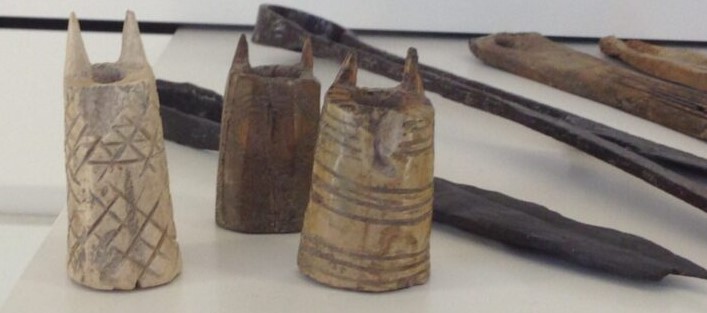
Image from Wikipedia – Arkéos Musée, Douai (France).
Luceting!
Making cord with a lucet is an easy & fun way to create shoe laces (or any kind of cord), you can use all your scrap yarn &, best of all, I do not believe there is any moment in my life I ever get bored!!
Bibliography/notes
[1] Sylvia Groves
The History of Needlework Tools and Accessories
Hamlyn Publishing Group Ltd, Middlesex
1966, republished 1973
[2] The Textile Institute
Textile Terms and Definitions 8th Edition
1986
More sources
https://www.lrcrafts.it/lucet-cordmaking-history/: LUCET
