
Mordanting protein fibres
Mordanting is the most important step to prepare the fibres to accept the colour during the dye process. The mordant is what ensures that the plant dye is “fixed” on the fibre, giving durable and time-lasting colours. With few exceptions (avocat, pomegranate & onion skins, curcuma & indigo), plant dyes need the use of a mordant.
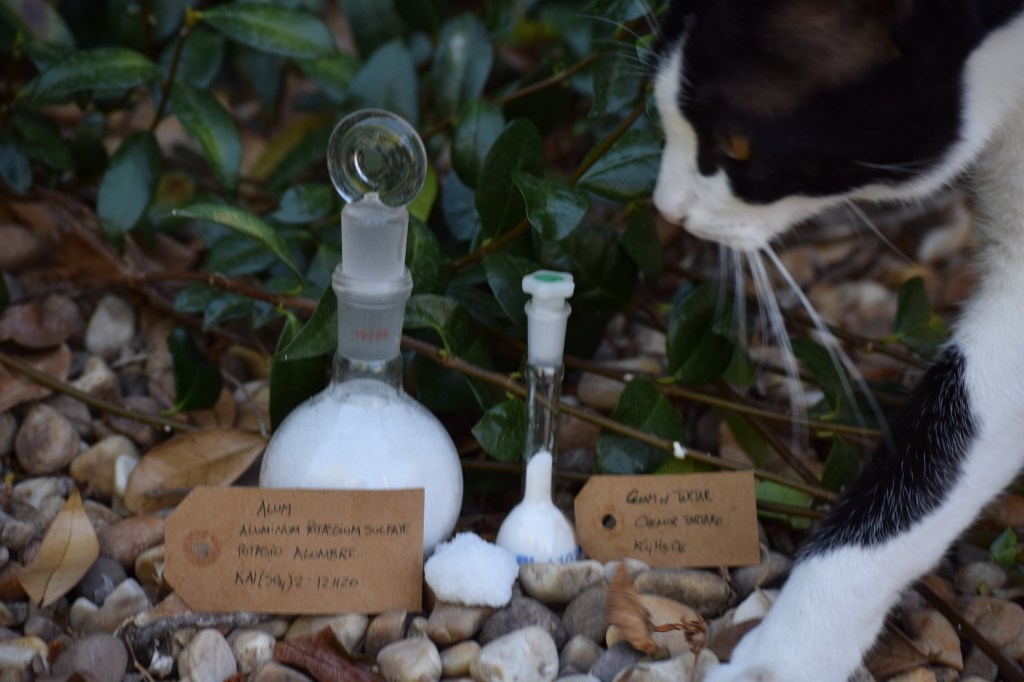
The most frequently used mordants for protein fibres are mineral salts, like Aluminum Sulfate (Al2(SO4)3) or Aluminum Potassium Sulfate (KAl(SO4)2), commonly known as Alum. Other mineral salts like chrome, lead or tin sulfates have been use in the past for mordanting, however, owing to their deleterious effect both in the health & the environment, its use is not recommended
Mordanting protein fibres with Alum – standard mordanting recipe

- Weight the fibres dry (WOF) & then submerge them in water. Mordanting wet fibres ensures that the mordant is distributed evenly.
- Weight alum at 15% WOF. Optionally you can add 6% WOF of cream of tartar. The cream of tartar is used to assist the alum to bond with the fibre & to keep the fibres soft. However, it can shift certain colours (for example with madder it will shift the hue to orange and with cochineal and lac the colour will become a brighter red). Additionally, it can inhibit the development of certain shades in logwood & some tannins, so it should be used carefully.
- Dissolve the alum (and the optional cream of tartar) in a cup of hot water.
- Add the dissolved alum (or alum + cream of tartar) to a dye pot (preferably made of a non-reactive container like stainless steel) with enough warm water to cover the fibres when they are added, at least a 20:1 ratio of W/F & stir the mix well.
- Add the wet fibres & increase the temperature gradually to a soft boil (85-90 ºC), for about 1h-1h30´, stirring the fibres frequently so the alum is evenly distributed.
- Let cool the fibres in the mordanting bath & once cooled down, remove & rinse them in cold water. You can use them in your dye bath immediately or you can let them dry to use at a later moment.
As mentioned before, Alum is the most commonly used mordant, because it is easy to use & reasonable safe. However, can mordanting with Alum be certainly considered an ecological process?
On the one hand, some people argue that the innocuity of the use of Alum for the health is a subject of discussion. On the other hand, the process for sourcing Alum has a negative impact on the natural environment and the local population.
Is there, then, a more ecological alternative for mordanting protein fibres?
Mordanting protein fibres without Alum
There are some plants (like avocat, onion & pomegranate skins, curcuma, indigo…) that do not need the use of a mordant to give a durable & light-fast dye. Therefore, some plants are of great interest in our research to mordanting with plant materials. To mordant protein fibres without Alum, we need to select plants with specific chemical compositions, plants rich in aluminum, tannins or oxalic acid.
Plants rich in tannins
There are many plants rich in tannins that can be use as mordants, commonly black oak, pomegranate, cutch, fustic, etc. However, it is important to know that tannins can produce a clear result or they can add some colour to the fibre & this needs to be taken in consideration when selecting a tannin for mordanting.
- Tannins that give an almost clear shade: oak galls (6-8% WOF), Sumac (leaves & galls), Tara (pods)
- Tannins that give a yellow shade: Pomegranate, Black Oak, Fustic, Henna
- Tannins that give a red-brown shade: Tea leaves, Cutch, Quebracho
Plants rich in aluminum
Aluminum (Al) is the third most abundant of the chemical elements in the lithosphere. Highly acidic soils affect plants that are not- or only poorly adapted to aluminum toxicity. However, some plants like, tea plants (Camellia sinensis), are well adapted & have developed strategies that allows them to grow in acid soils with high Al availability. These plants not only have the ability to accumulate high concentrations of aluminum in their aerial parts, but also respond with growth stimulation.
Although, most Al hyper-accumulator plants are tropical shrubs or trees, like some species from the Miconia; Palicourea or Vochysiaceae families. Some of the better-known examples of Al hyper-accumulator plants historically use in Europe include Lycopodium spp. (Clubmosses), as well as various members of the Asteraceae, Fabacaea, Brassicaceae, and Symplocaceae plant families. In addition, other cultivated species can be considered Al hyper-accumulators: tea, buckwheat & Hydrangea.
The aluminum concentrated on the aerial parts of this plants can be use, after its extraction through decoction, as a plant mordant.
Sweetnam, M. (2020). Plant Derived Mordants. Mamie’s Schoolhouse. https://www.mamiesschoolhouse.com/blogarchive/2020/4/25/a-new-approach-to-plants-as-mordants
Plants rich in oxalic acid
Many plants accumulate oxalic acid (C2H2O4) as oxalate crystals on their leaves as a defence mechanism against herbivores, some of the plants with higher concentration on oxalic acids are cassava, chives, parsley, as well as carrot, rhubarb, beet, sorrel & spinach leaves…
Oxalic acid has a been frequently used to improve the affinity of Alum to protein fibres. Through experimentation, some researchers have obtained excellent results mordanting protein fibres using only plant material rich in oxalic acid. My own explorations have resulted in rich & durable colours.
Mordanting protein fibres with plants rich in oxalic acid – beet/spinach standard mordanting recipe
Materials
- A 5L. pot, preferably of a non-reactive material (p.e. stainless steel)
- 100% weight of the fibre to dye (WOF)
- 200% WOF of fresh beet or spinach leaves or 100% WOF of dry leaves
Process
- Extracting the beet/spinach mordant
- Cut the leaves (fresh or dry), place them in the pot & cover with water (if possible, rain or distilled water)
- Heat in a ventilated area, increasing the temperature gradually to almost boiling point & stir frequently. If necessary, add more water, making sure the leaves stay completely covered
- Continue in a soft boil for 1h-1h30´, then switch off the heat & let cool down
- Filter through a cheesecloth over a colander
The liquid obtained can be stored in hermetic jars or use immediately. It will have a pinkish/greenish colour because of the natural pigments present. In beetroot these pigments are betalains (yellow-orange betaxantins or red-violet betacyanines). Unfortunately, betalaines are very sensitive toward light, heat, pH & oxygen, so the use of beet as a dye is very limited, giving very bright but fugitive colours. Fortunately, we are using the beet, not as a dye, but as a mordant!
- Mordanting the fibres
- Submerge the fibres in a container with water. Dyeing wet fibres ensures that the dye is distributed evenly.
- Place the “beet/spinach mordant” in a big enough pot to cover the fibres. In my experiments I used a 10L. pot
- Add more water (rain or distilled if possible) to cover the fibres completely
- Introduce the fibres in the mordanting bath & increase the temperature gradually to a soft boil
- Stir frequently & if necessary, add more worm water to ensure that the fibres stay covered
- Continue in a soft boil for about 1h, then switch off the fire & let cool down
- Once the bath has cool down you can remove the fibres & squeeze the excess of water
You can use the fibres directly to dye or let them dry for later use. The fibres will have a slight pink colour, but that should not interfere with the posterior dye. In fact I find that this adds complexity & interest to the final result
 TeresaLaLana